AI helps with one task
Ask AI to draft an email or social post. You check it and finish the job.
Next step: Pick a task your team repeats.

AI adoption
Maybe you use AI to write a customer message. Maybe it helps your office team follow up on inquiries. Or perhaps you have given it a regular job to handle, with someone checking the results.
Each is a different way of putting AI to work. Find the level that sounds like your business today, then see what taking the next step would mean for your team.
Find where you stand Explore the four levels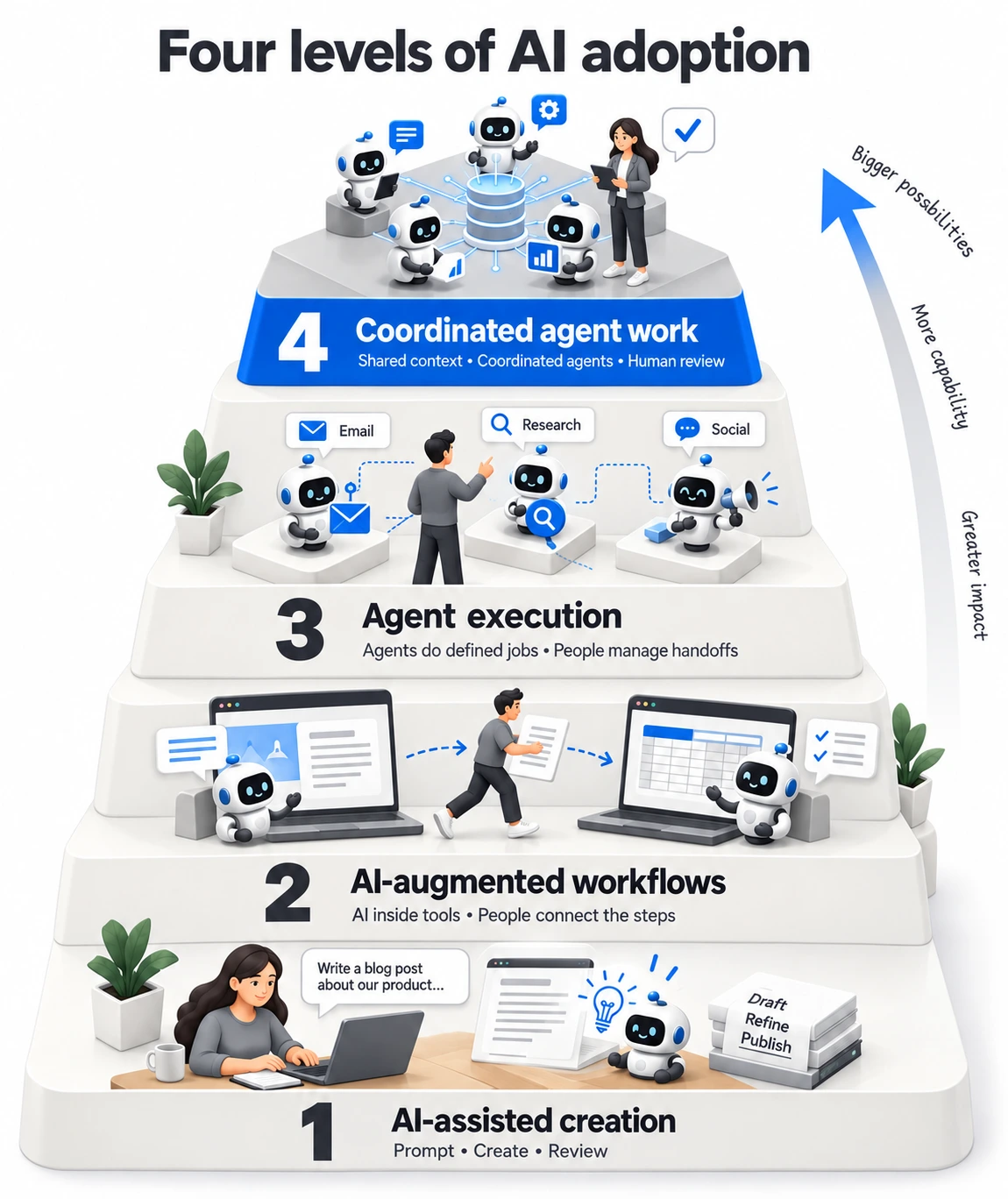
How the work changes
Each level gives AI more of the work. Your team stays in charge.
Ask AI to draft an email or social post. You check it and finish the job.
Next step: Pick a task your team repeats.
Your existing software suggests a reply or drafts an update. Your team still moves the work along.
Next step: Find the manual steps that still slow you down.
Give an AI helper a recurring job, like checking website content each week. Your team reviews its work.
Next step: Set clear instructions and approval rules.
One helper finds content ideas; another drafts posts. They share your business information, while your team directs and approves the work.
Next step: Check the whole result before adding more jobs.
Start where it helps. You do not have to reach level four.
Your next step
Answer six quick questions about how your team works. Get a suggested starting point, three next steps, and a job to try. We'll email you a PDF report to keep.
AI adoption, made manageable
BoastAble meets you where you are, whether you're trying your first AI task or ready to connect several helpers. We agree on a manageable piece of marketing work, then handle setup and training, with one year of support.
You keep a full BoastOS license: software built to make working with AI feel familiar. Assign jobs from a to-do list, give instructions through chat, and review the work before it goes out. We hand over the keys and stay available when you need help.
Talk about your next stepSee the $4,995 engagement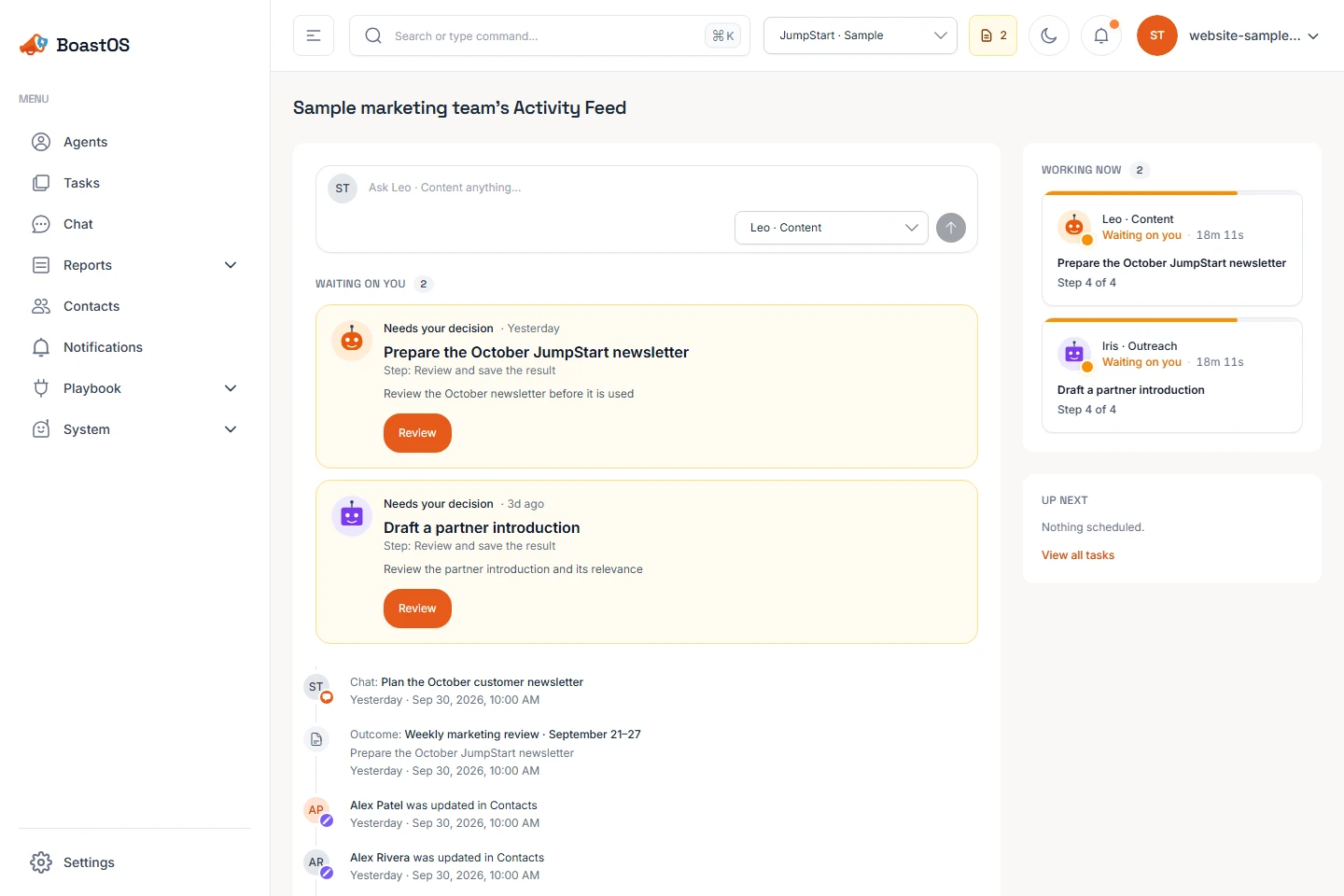
What the research tells us
Even among marketing leaders, AI often helps with individual tasks rather than a connected job.
Our advice: start with one recurring marketing task, then connect the steps around it.
Boston Consulting Group's 2026 survey of 300 chief marketing officers found that 42% used generative AI only to assist with individual tasks, while about 8% connected multiple agents for certain autonomous campaigns. The survey uses different categories from the four levels above.
Gartner's earlier survey of 418 marketing leaders found creative development was a common starting point: 77% of organizations that had adopted generative AI used it for that work.
Boston Consulting Group's 2026 survey · Gartner's survey, conducted in 2024
People working with AI made more ads in one study. The live ads performed broadly similarly.
Our advice: include review time and corrections before calling it a saving.
A randomized ad-creation study with 2,234 participants found human-AI teams produced 50% more ads per human worker and made 62% fewer direct text edits. Copy quality improved, but image quality and variety suffered; overall live ad performance was broadly similar.
Amazon Web Services reports that BlueOcean's service, which uses AI helpers for separate jobs, reduced some customer analysis tasks from about five days to two hours. That is a vendor-reported case study with its own data and service, rather than a result you can assume for your business.
Ju and Aral's working paper · Amazon Web Services' BlueOcean case study
Try one job. Compare before and after.
Include setup, checking and fixes.
Count finished work your team approves.
Include the tools and people involved.
Adapted from the BoastOS research brief with AI-assisted drafting and review. Research examples concern specific studies and services, not measured BoastAble results. Prepared by the BoastAble team.